Kern
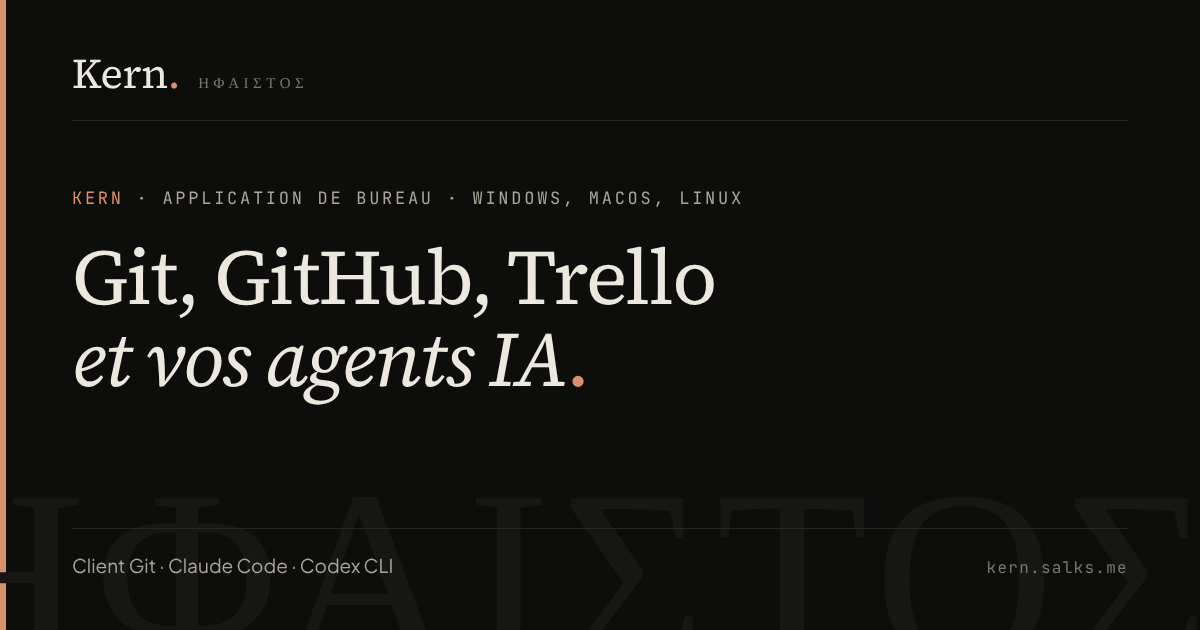
A desktop app that brings together Git, GitHub, Trello and AI agents.
Kern is a desktop Git client for Windows, macOS and Linux. You go from a GitHub issue to a branch to a pull request, with Codex CLI or Claude Code working in the right project. The code stays on your machine.
Where it started
When you work on several projects, you juggle a Git client, GitHub in the browser, a Trello board, your editor and now command-line AI agents. Context gets lost with every window switch. Kern brings them into one app with one rule: each screen maps to a real operation and shows what will be read, changed, tested or published.
What you do in it
- Full Git: add a local repository or clone from GitHub, stage files, review the diff, commit, then controlled fetch, rebase and push. The branch tree is drawn on a real graph, with the details of each commit.
- Issues and pull requests: from an issue, Kern creates the branch, hands the request to the agent and follows the fix up to the pull request. Creating, discussing, reviewing files, resolving conflicts and squash-merging happen without leaving the app. Tags and GitHub releases too, created as drafts.
- Agents: Codex CLI and Claude Code get the prompt, the project memory, its rules and the expected checks. You choose their profile and autonomy level (manual, plan or automatic), and an agent terminal is built in.
- Trello: one board and list per project, connected through the site without typing a key.
- Several projects: a map links repositories together (dependency, API, package, deployment) to show what a change affects.
Security
Repositories stay on the computer: the site never receives their content. GitHub sign-in uses OAuth with PKCE; the app secret never leaves the server, exchange tickets are encrypted, single-use and deleted after ten minutes, and the final token is stored in the system keychain (Windows, macOS or Linux).
How it’s built
The desktop app uses Tauri 2: the interface in React and TypeScript, the system side (Git, GitHub, Trello, agents, storage) in Rust. The Next.js site serves the landing page and the authentication routes; the documentation lives on Chronos. Each platform has its installer: a fully custom Windows setup, a macOS DMG and Linux packages.
Kern is in private preview. Test builds are shared on the project’s Discord.
Gallery